
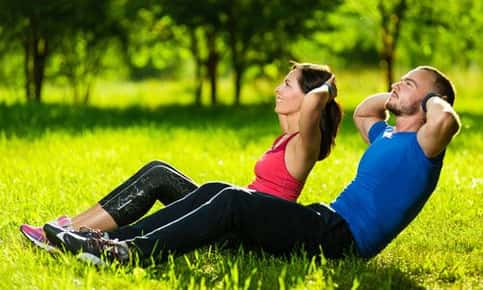
The abs rule. As a result of this not-so-subtle imperative, a flat abdominal musculature is one of the primary goals of all exercise programs. Flat abdominals have great aesthetic appeal, not only to the "owner" of those abs, but also to the person's spouse or partner.
Of course, a flat abdominal musculature is necessarily strong, and strong abs yield substantial health benefits. Strong abs provide biomechanical support for the weight-bearing activities of the lower back, pelvis, and hips. Strong abdominal muscles help distribute weight evenly across these bony structures, making weight-bearing more efficient and preventing injury to regional muscles, ligaments, and tendons.1,2
The second key function of strong abdominals is to support the respiratory system. By providing a resilient shell or casing to house the abdominal viscera, that is, the stomach, liver, intestines, and other organs, strong abdominals create a robust environment in which the diaphragm can achieve full function. The result is maximum respiratory capacity and the capability of fulfilling all the oxygen and other metabolic demands of a healthy organism.
It's useful to recognize that the washboard abs featured on the covers of fitness magazines and in advertisements for fashion and other personal accessories are merely the most superficial result of abdominal muscle fitness. The rippling effect is due to a highly trained rectus abdominis, the top layer of the abdominal muscle group. But the three other layers, the internal obliques, external obliques, and transversus abdominis, are even more important in terms of physiology and function. The takeaway here is that doing abdominal crunches or other variations of sit-ups is not enough to achieve all the health benefits of well-trained abdominals. A complete exercise routine is required in order to effectively involve the three deeper abdominal layers.
These complete routines are known as core exercises.3 The notion of a core references the center-creating function of the abdominal muscles. Many of the basic core exercises are identical to those done by fitness enthusiasts going back almost a century, such as squats, push-ups, and jumping jacks. Core exercises include the plank, hip bridge and lunges. One of the great benefits of doing core exercises is that no equipment is required other than an exercise mat. No gym membership is needed, as all of the core exercises can be done at home or at a local park.
Since the core abdominal muscles provide support for all weight-bearing activities and stabilize the entire biomechanical structure, persons whose core muscles are deconditioned are more susceptible to all types of musculoskeletal injuries, especially painful strains and sprains of the neck and lower back. Regular chiropractic care helps you get the most out of your abdominal muscle training program. By detecting and correcting nerve interference and spinal joint dysfunction, regular chiropractic care helps ensure optimal functioning of your spinal column and its associated muscles, tendons, and ligaments.
In this way, regular chiropractic care provides a flexible and resilient framework for a complete and thorough core strengthening workout. Core exercises are easy to do and provide noticeable benefits within a very short time. As with all physical fitness activities, the most important thing is to get started so you and your family can start enjoying long-term fitness and improved wellness.
- Steele J, et al: A review of the specificity of exercises designed for conditioning the lumbar extensors. Br J Sports Med 49(5):291-297, 2015
- Coulombe BJ, et al: Core Stability Exercise Versus General Exercise for Chronic Low Back Pain. J Athl Train 52(1):71-72, 2017
- Wieland LS, et al: Yoga treatment for chronic non-specific low back pain. Cochrane Database Syst Rev 2017 Jan 12;1:CD010671. doi: 10.1002/14651858.CD010671.pub2