
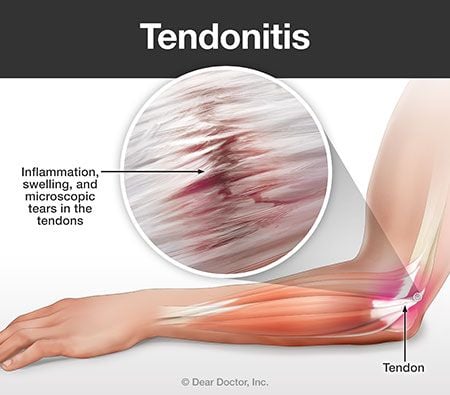
When tendons, the bands of tissue that attach your muscles to your bones, become inflamed or irritated, you have tendonitis. The most common sites for tendonitis are elbows, wrists, knees and heels, though any tendon can become inflamed.
Tendons are made of a tough, flexible tissue. They can be small, like those in the hands, or thick and ropelike, like the tendons in the thigh. Tendonitis is usually caused by overuse, such as throwing a ball too often or increasing physical activity too rapidly, like when you start a new exercise regimen. You can help prevent tendonitis by stretching before physical activities. This can increase your range of motion and will help keep you from catching a tight ligament off guard.
Some common musculoskeletal complaints that go by other names are actually tendonitis. These include “tennis elbow,” “golfer’s elbow,” “jumper’s knee” and “pitcher’s elbow.” But you don’t have to play sports to develop tendonitis. Tendons can also become inflamed from activities like gardening, carpentry, other repetitive tasks or even household chores. Left untreated, tendonitis can lead to chronic pain and secondary injury, but chiropractic care can help your tendonitis heal naturally.
Symptoms of Tendonitis
Tendonitis causes pain in the tissues surrounding a joint. In some cases, the joint may feel weak and the area may be red, swollen and warm to the touch. Your specific symptoms depend on which area of your body is affected:
- Shoulder tendonitis, sometimes called “swimmer’s shoulder” or “pitcher’s shoulder,” is due to an inflammation of the rotator cuff, the combination of tendons and muscles that stabilize your shoulder. The tendons may get overworked or pinched and cause a dull, aching pain that can extend to the upper arm and feel worse at night, even disrupting sleep. Swelling, shoulder weakness and limited range of motion may also result.
- “Tennis elbow” causes pain in the outer side of the elbow, which may extend down to the wrist. It develops when the tendons that connect your forearm to your elbow become stressed and inflamed where they connect to the bony part of the elbow on the outside of your arm.
- “Golfer’s elbow” causes pain in the inner side of the elbow. It’s an inflammation of the tendons of your forearm where they attach muscles to the bony bump on the inside of your elbow. The pain might spread into your forearm and wrist. A similar condition is called “pitcher’s elbow,” which affects other tendons of the inner elbow.
- “Jumper’s knee” is experienced as pain near the knee, and it often affects basketball or volleyball players. It’s an inflammation of the tendon that connects the kneecap (patella) to the shinbone (tibia). The pain is usually felt below the kneecap but may also be slightly above it.
- De Quervain’s tenosynovitis, or De Quervain’s disease, results in pain near the base of the thumb. It can hurt when you turn your wrist, grasp an object or make a fist. De Quervain’s disease can be caused by repetitive movement of the wrist or hand as from gaming or racquet sports, or from direct trauma to the thumb.
- Achilles tendonitis is felt as pain in the back of the heel or slightly above it. The Achilles tendon connects the calf muscles at the back of the leg to the heel bone. Achilles tendonitis is common in runners who suddenly increase the distance or intensity of their runs, and it is more likely when wearing poorly fitting shoes.
Treatment of Tendonitis
When you have tendonitis, you should limit use of the affected area. It may take weeks of rest to allow the body to heal, but chiropractic treatment can help speed up the process without drugs, steroid injections or surgery. Chiropractors can treat tendonitis using adjustments and techniques designed to break up scar tissue, reduce inflammation and return normal function to the affected area.
Treatments may include anti-inflammatory therapies such as low-level laser or electrotherapy to help with tissue repair. Anti-inflammatory supplements may also be recommended. If you have scar tissue, which can impede mobility, chiropractors can break up the adhesions, promoting faster healing by increasing blood flow to the area. When appropriate, chiropractors can also recommend rehabilitative exercises. If you have signs of tendonitis, ask us how we can encourage your body to heal using safe and effective methods.